Table of Contents
Artificial intelligence has advanced dramatically over the past decade. Early AI systems were designed to solve specific problems such as recognizing images, filtering spam emails, or recommending products. Today, NextGen AI (Next Generation AI) is transforming the technology landscape with systems that can reason, learn continuously, and perform multiple complex tasks.
Leading organizations such as OpenAI, Google DeepMind, and Anthropic are building advanced AI models that go far beyond the capabilities of traditional AI systems.
We’ll explore the key differences between traditional AI and next-generation AI, including their capabilities, technologies, and real-world applications.
What Is NextGen AI?
NextGen AI refers to advanced artificial intelligence systems capable of performing multiple tasks, reasoning through problems, and interacting naturally with humans.
Unlike traditional AI, next-generation AI models are designed to be more flexible, intelligent, and adaptable.
They often combine several advanced technologies, including:
- large language models
- multimodal AI
- autonomous agents
- reinforcement learning
Companies such as OpenAI and Google DeepMind are developing AI models capable of understanding complex instructions and generating human-like responses.
What Is Traditional AI?
Traditional AI refers to earlier artificial intelligence systems designed to perform specific tasks using predefined algorithms and large training datasets.
These systems are often called narrow AI because they specialize in one function.
Examples of traditional AI include:
- email spam filters
- recommendation engines
- voice assistants with limited capabilities
- image recognition software
Traditional AI systems rely heavily on supervised learning, where models are trained on labeled datasets to recognize patterns.
While these systems can be highly effective within their domain, they typically cannot adapt to tasks outside their training.
Key Differences Between NextGen AI vs Traditional AI
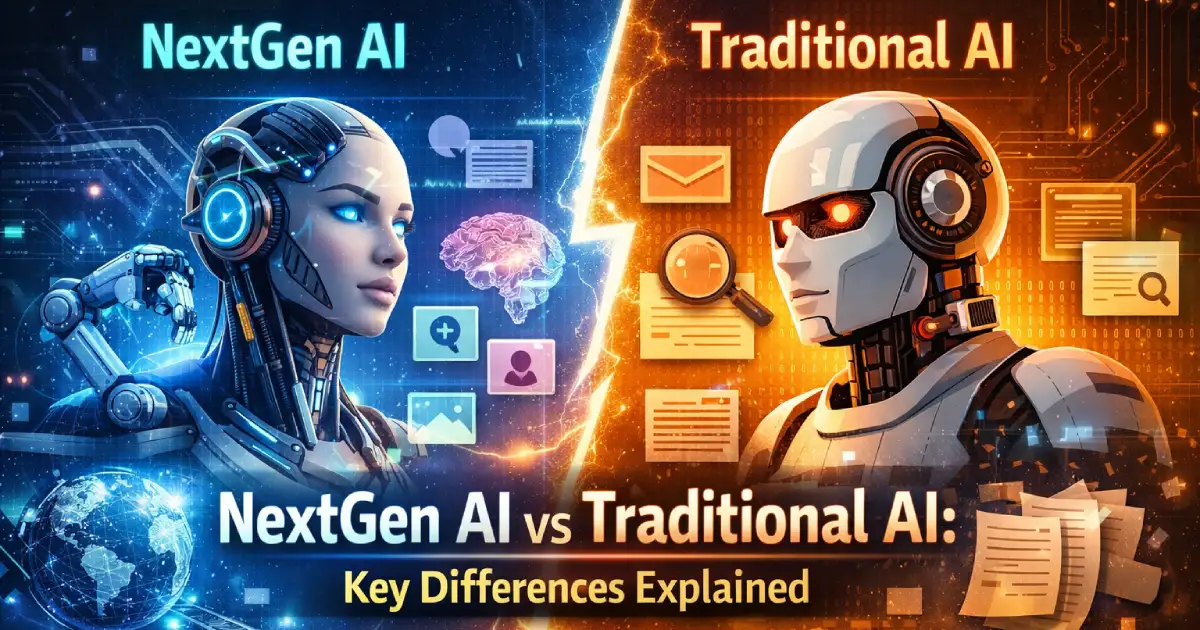
Difference between NextGen AI and Traditional AI
1. Task Capability
Traditional AI systems are designed to perform single, specialized tasks.
For example:
- a model trained to recognize faces cannot automatically perform language translation.
NextGen AI systems are multi-functional, meaning they can handle a wide variety of tasks within the same system.
Examples include:
- writing articles
- answering questions
- generating images
- analyzing data
- writing software code
2. Learning and Adaptability
Traditional AI systems depend on static training data. If new data or tasks arise, the system usually needs to be retrained.
Next-generation AI systems are designed with adaptive learning capabilities, allowing them to handle new situations more effectively.
This makes them far more useful in rapidly changing environments.
3. Data Processing Capabilities
Traditional AI systems typically process one type of data, such as text or images.
NextGen AI models can process multiple types of data simultaneously, including:
- text
- images
- audio
- video
- code
This capability is known as multimodal AI, and it allows AI systems to understand complex real-world information.
4. Reasoning and Problem-Solving
Traditional AI focuses mainly on pattern recognition.
NextGen AI introduces more advanced reasoning abilities, allowing systems to:
- break down complex problems
- analyze information step-by-step
- generate logical solutions
AI research teams at Google DeepMind are actively working to improve reasoning capabilities in modern AI systems.
5. Human Interaction
Traditional AI systems often rely on simple commands or structured inputs.
NextGen AI models are capable of natural conversations and contextual understanding.
Users can interact with AI systems using normal language, making them easier and more intuitive to use.
Real-World Examples
Traditional AI Examples
Some common examples of traditional AI systems include:
- recommendation systems used by streaming platforms
- fraud detection systems in banking
- image recognition used in social media platforms
- rule-based chatbots used in customer support
These systems perform well within their specific domain but struggle with broader tasks.
NextGen AI Examples
Next-generation AI systems are capable of handling more complex workflows.
Examples include AI models developed by OpenAI and Anthropic that can:
- write content
- generate code
- analyze documents
- assist with research
- automate workflows
These systems are becoming powerful productivity tools across many industries.
Benefits of NextGen AI
Next-generation AI offers several advantages compared to traditional AI systems.
Increased versatility
A single AI system can perform multiple tasks.
Better problem-solving
Improved reasoning capabilities enable AI to handle complex challenges.
Enhanced user experience
Natural language interaction makes AI easier to use.
Greater productivity
AI can automate a wide range of tasks, saving time and resources.
Challenges of NextGen AI
Despite its many advantages, next-generation AI also introduces new challenges.
High computational requirements
Advanced AI models require powerful hardware and large datasets.
Ethical and safety concerns
Ensuring responsible AI development is an ongoing challenge.
Organizations such as OpenAI and DeepMind are investing heavily in AI safety research.
The Future of AI
The transition from traditional AI to next-generation AI is only the beginning.
Future developments may include:
- more autonomous AI agents
- improved reasoning systems
- better human-AI collaboration
- progress toward Artificial General Intelligence (AGI)
These advancements could significantly transform industries and daily life.
Frequently Asked Questions
1. What is the main difference between NextGen AI and Traditional AI?
The main difference is capability and flexibility. Traditional AI systems are designed to perform a single specialized task, such as spam filtering or image recognition. NextGen AI systems can perform multiple tasks, reason through complex problems, and interact with users using natural language.
2. What is Traditional AI?
Traditional AI refers to early artificial intelligence systems built to perform specific tasks using predefined algorithms and training datasets. These systems are often called narrow AI because they focus on a single function such as recommendation systems, fraud detection, or email spam filtering.
3. What is NextGen AI?
NextGen AI, or next-generation artificial intelligence, refers to advanced AI systems that can understand and process different types of data, reason through complex problems, and perform multiple tasks within the same system. These models often use technologies like large language models, multimodal AI, reinforcement learning, and autonomous agents.
4. What are examples of Traditional AI systems?
Common examples of traditional AI include recommendation engines used by streaming platforms, spam filters in email services, fraud detection systems in banking, rule-based chatbots, and image recognition tools used in social media platforms.
5. What are examples of NextGen AI systems?
Examples of next-generation AI include advanced AI models that can generate content, analyze documents, answer complex questions, write software code, and assist with research. These systems are being developed by leading organizations in the AI industry.
6. What are the advantages of NextGen AI?
NextGen AI provides several advantages including improved reasoning abilities, the ability to handle multiple tasks, better human-AI interaction through natural language, and the ability to automate complex workflows across industries.
7. What is multimodal AI in NextGen AI systems?
Multimodal AI refers to the ability of an AI system to process and understand multiple types of data such as text, images, audio, video, and code simultaneously. This capability allows AI to better understand real-world information and perform more complex tasks.
8. What challenges does NextGen AI face?
NextGen AI faces challenges such as high computational costs, the need for large training datasets, and concerns related to ethical AI development, safety, and responsible use of artificial intelligence technologies.
9. Will NextGen AI replace Traditional AI?
NextGen AI is expected to complement and expand traditional AI rather than completely replace it. Many industries will continue using traditional AI for specialized tasks while adopting next-generation AI for more complex and multi-functional applications.
Conclusion
Traditional AI laid the foundation for modern artificial intelligence, but NextGen AI represents a major leap forward.
With capabilities such as multimodal understanding, advanced reasoning, and autonomous task execution, next-generation AI systems are far more powerful and versatile than earlier technologies.
As research continues at organizations like OpenAI and Google DeepMind, next-generation AI will continue to reshape how humans interact with technology.