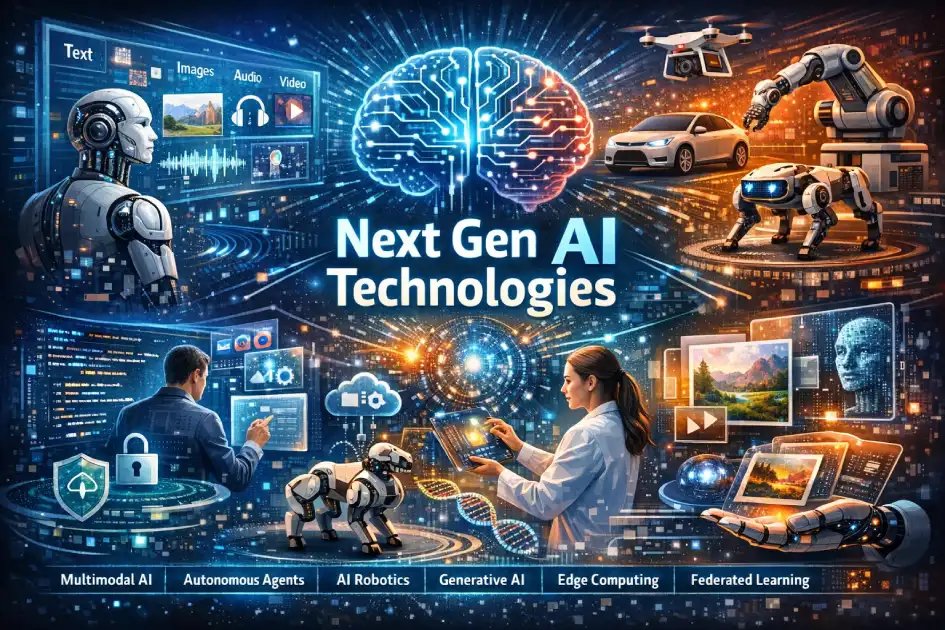
Artificial intelligence is evolving faster than ever before. While early AI systems focused on narrow tasks like image recognition or recommendation engines, the next generation of AI technology is designed to be far more powerful, adaptable, and intelligent. Major tech companies such as OpenAI, Google DeepMind, and NVIDIA are developing advanced AI technologies that can reason, understand multiple types of data, and perform complex decision-making tasks.
Table of Contents
10 Next Gen AI Technology Innovations
These 10 innovations are shaping the future of industries including healthcare, finance, transportation, education, and software development.
1. Multimodal AI
One of the biggest breakthroughs in next-generation AI is multimodal intelligence.
Traditional AI models could only process one type of data at a time, such as text or images. Multimodal AI can process and understand multiple forms of data simultaneously, including:
- text
- images
- audio
- video
- code
For example, AI systems developed by OpenAI can analyze images, answer questions about them, and generate written explanations. This ability allows AI to interact with the world in a much more human-like way.
2. Large Language Models (LLMs)
Large Language Models are one of the most important technologies behind next-gen AI.
These models are trained on massive datasets to understand and generate human language.
LLMs can:
- write articles
- answer complex questions
- summarize documents
- generate computer code
- assist with research
Companies like Anthropic and OpenAI have developed powerful language models that are transforming how people interact with computers.
3. AI Reasoning Systems
Earlier AI models focused mostly on pattern recognition.
Next-generation AI introduces advanced reasoning capabilities, allowing machines to solve problems step-by-step.
These systems can:
- solve math problems
- analyze complex datasets
- debug software code
- plan multi-step tasks
AI research labs such as Google DeepMind are investing heavily in reasoning-based AI systems.
4. Autonomous AI Agents
Another revolutionary development is autonomous AI agents.
AI agents are systems capable of independently performing tasks without constant human supervision.
They can:
- plan tasks
- execute actions
- interact with software tools
- improve outcomes through feedback
For example, AI agents can automatically:
- manage emails
- conduct research
- automate business workflows
- operate software systems
This technology is expected to dramatically increase productivity in the coming years.
5. Edge AI
Edge AI allows artificial intelligence to run directly on devices rather than relying on cloud servers.
This means AI can operate on:
- smartphones
- smart cameras
- IoT devices
- autonomous vehicles
Companies like NVIDIA are developing specialized chips that enable powerful AI processing at the edge.
Benefits of Edge AI include:
- faster response times
- improved privacy
- reduced internet dependency
6. Reinforcement Learning
Reinforcement learning is a technique where AI learns by trial and error through rewards and penalties.
This technology is used to train AI systems in complex environments such as:
- robotics
- game strategy
- autonomous driving
- logistics optimization
Breakthroughs in reinforcement learning helped researchers at DeepMind create AI systems capable of defeating human champions in strategy games.
7. AI-Powered Robotics
Robotics combined with next-generation AI is enabling machines to perform complex physical tasks.
AI-powered robots can:
- navigate environments
- recognize objects
- perform precise movements
- collaborate with humans
Industries using AI robotics include:
- manufacturing
- healthcare
- logistics
- agriculture
These robots are becoming more adaptable thanks to advances in machine learning and sensor technology.
8. AI Hardware Acceleration
Advanced AI systems require enormous computing power. To support this demand, companies are developing specialized AI hardware designed specifically for machine learning workloads.
Examples include:
- GPUs
- AI accelerators
- neural processing units (NPUs)
Companies like NVIDIA are leading the development of high-performance chips used to train and run modern AI models.
9. Federated Learning
Federated learning allows AI models to learn from data without transferring that data to a central server.
Instead, models are trained locally on devices, and only the learning updates are shared.
Benefits include:
- stronger privacy protection
- reduced data transfer
- improved security
This technology is particularly useful for industries dealing with sensitive information such as healthcare and finance.
10. Generative AI
Generative AI is one of the most visible forms of next-generation artificial intelligence.
These systems can create entirely new content, including:
- text
- images
- music
- videos
- software code
AI tools powered by generative models are being widely used in creative industries, marketing, and software development.
Companies like OpenAI and Anthropic are leading advancements in this field.
What are the benefits of next gen AI technology?
Next-gen AI technologies offer significant benefits across industries.
Increased productivity
Automation allows businesses to complete tasks faster and more efficiently.
Better decision making
AI can analyze massive datasets and provide insights that humans might miss.
Improved customer experiences
AI systems can deliver personalized services and faster support.
Accelerated innovation
AI helps researchers solve complex problems in science, medicine, and engineering.
What are the challenges of next generation AI technology?
Despite its potential, next-generation AI also presents challenges.
Ethical concerns
Ensuring responsible AI development is critical to prevent misuse.
Data privacy
AI systems often require large datasets, raising privacy concerns.
High computing costs
Training advanced AI models requires significant computational resources.
Organizations such as OpenAI and DeepMind are actively researching ways to make AI safer and more efficient.
Frequently Asked Questions (FAQs)
What is next generation AI technology?
Next generation AI technology is designed to be far more powerful, adaptable, and intelligent. These innovations are shaping the future of industries including healthcare, finance, transportation, education, and software development.
What is multimodal AI?
Multimodal AI can process and understand multiple forms of data simultaneously, including text, images, audio, video, and code. This ability allows AI to interact with the world in a much more human-like way.
What are Large Language Models (LLMs)?
Large Language Models are trained on massive datasets to understand and generate human language. They can write articles, answer complex questions, summarize documents, generate computer code, and assist with research.
What are autonomous AI agents?
AI agents are systems capable of independently performing tasks without constant human supervision. They can plan tasks, execute actions, interact with software tools, and improve outcomes through feedback.
What is Edge AI?
Edge AI allows artificial intelligence to run directly on devices rather than relying on cloud servers. Benefits include faster response times, improved privacy, and reduced internet dependency.
What is generative AI?
Generative AI systems can create entirely new content, including text, images, music, videos, and software code. AI tools powered by generative models are being widely used in creative industries, marketing, and software development.
Conclusion
Next Generation AI technology is transforming the way humans interact with machines. From multimodal intelligence and autonomous AI agents to powerful generative models, these innovations are pushing the boundaries of what artificial intelligence can achieve.
As research continues to advance, next-generation AI technologies will play a crucial role in shaping the future of industries, economies, and everyday life.