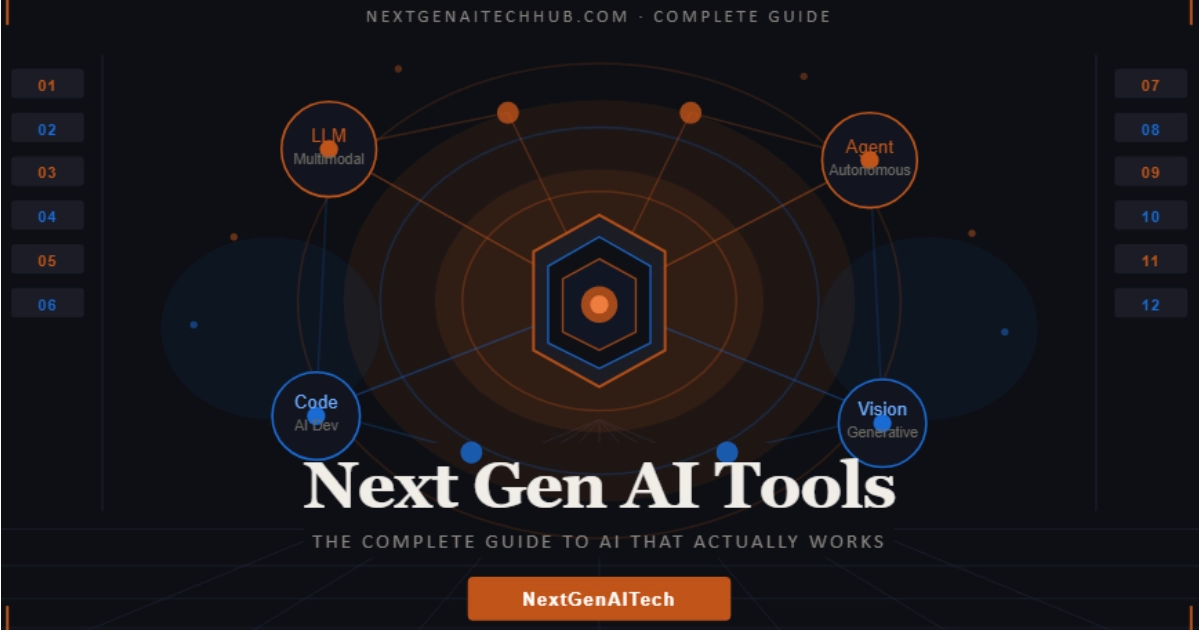
From multimodal reasoning engines to autonomous coding agents — we cut through the noise and show you which Next Gen AI technologies are transforming real work right now, and how to stay ahead of the curve.
Table of Contents
1. What Is Next Gen AI in 2026?
If you asked someone to define Next Gen AI just three years ago, they’d probably describe a chatbot that could write a decent email. Today, the term means something radically different — and exponentially more powerful.
Next Gen AI in 2026 refers to artificial intelligence systems that can reason across multiple modalities (text, images, audio, video, and code), take autonomous actions in the real world, and continuously learn from context without requiring manual retraining. These systems don’t just answer questions — they plan, execute, evaluate, and iterate.
At NextGen AI Tech, we define Next Gen AI by three core characteristics:
- Multimodal understanding: Reading, seeing, and listening — all at once.
- Autonomous operation: Setting goals, making plans, and completing multi-step tasks without hand-holding.
- Contextual reasoning: Understanding nuance, ambiguity, and long-range dependencies that tripped up every previous AI generation.
2. Why Next Gen AI Matters More Than Ever
We’re no longer in a period of AI experimentation. We’re in a period of AI deployment. Businesses that built AI strategies in 2023 and 2024 are now reaping compound returns — while those still on the sidelines are falling dangerously behind.
The numbers tell a stark story:
| 78% | of Fortune 500 companies actively deploy Next Gen AI in core operations (2026) |
| $1.8T | global AI market value projected by end of 2026 |
| 3.2× | productivity multiplier reported by teams using AI agents for knowledge work |
| 40% | of new software shipped in 2026 contains AI-generated code components |
Beyond business, Next Gen AI is accelerating breakthroughs in drug discovery, climate modeling, materials science, and personalized education at speeds that human researchers alone could never achieve. This is not a technology trend — it’s an infrastructure shift as significant as the internet.
3. The 12 Next Gen AI Tools Dominating 2026
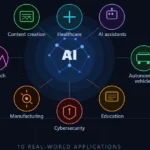
Below are the twelve categories of Next Gen AI technology that are reshaping how we work, create, and solve problems — with a clear breakdown of what each does, who it’s for, and why it matters.
| # | Tool & Description |
| 01 🔥 Most Impactful | Multimodal Large Language Models (LLMs) Process text, images, audio, and video simultaneously. Perfect for analysis that crosses media types. |
| 02 🔥 Trending | Autonomous AI Agents AI that receives a goal, breaks it into steps, uses external tools (browsers, APIs, code runners), and completes the task independently. |
| 03 ⚙️ Dev Essential | AI Coding Assistants Generate, review, explain, and debug code across all major languages. 2026 versions refactor entire codebases and write test suites autonomously. |
| 04 🔥 Explosive Growth | Generative Video AI Create photorealistic video from text prompts or still images. Used in marketing, film pre-production, and rapid prototyping. |
| 05 📚 For Researchers | AI Research Assistants Synthesize scientific literature, identify research gaps, generate hypotheses, and format citations — compressing weeks of review into hours. |
| 06 🏥 High Stakes | AI for Healthcare Diagnostics Analyze medical imaging, patient records, and genomic data. Now FDA-cleared for several use cases in radiology and pathology. |
| 07 🔥 Breakthrough | AI Reasoning Systems Dedicated models trained to solve complex logic, math, and strategic problems. Powers legal analysis and financial modeling. |
| 08 🎙️ Voice-First | Voice & Conversational AI Real-time voice agents with natural conversation flow, interruption handling, and emotional awareness. |
| 09 🔒 Critical Infra | AI-Powered Cybersecurity Detect anomalies, simulate attacks, and respond to incidents in milliseconds — faster than any human security team. |
| 10 🎓 EdTech | Personalized Learning AI Adaptive education platforms that identify each learner’s gaps, adjust pace in real time, and generate targeted exercises. |
| 11 🌍 World-Changing | AI for Climate & Science Run climate simulations, model protein folding, and predict extreme weather with unprecedented computational power. |
| 12 🚗 Physical World | AI in Autonomous Vehicles The brain behind Level 4 autonomy — processing sensor fusion, predicting pedestrian behavior, and making real-time navigation decisions. |
For deeper dives into several of these categories, explore the NextGen AI Tech blog at nextgenaitechhub.com/blog — including full guides on LLMs, generative AI, and real-world AI examples
4. How to Start Using Next Gen AI Today
You don’t need a PhD in machine learning to benefit from Next Gen AI right now. Here’s a practical, three-phase framework for individuals and teams at any skill level:
Phase 1: Augment (Weeks 1–4)
Start by adding AI to work you already do. Use an LLM to draft first versions of documents, summarize long reports, or generate code snippets. Measure the time saved. This phase builds intuition for what AI does well — and where it stumbles.
Phase 2: Automate (Months 2–3)
Identify repetitive, rule-based tasks that consume significant time: data entry, report generation, content scheduling, email triage. Use AI agents or workflow automations to handle these end-to-end. Free up human attention for judgment-intensive work.
Phase 3: Innovate (Month 4+)
Once you understand AI’s capabilities deeply, ask: what was previously impossible that’s now achievable? This is where Next Gen AI creates genuine competitive moats — personalized products at scale, real-time market intelligence, or entirely new service lines.
5. What’s Coming Next: AI Beyond 2026
If 2025 was the year of AI awareness and 2026 is the year of AI deployment, 2027 and beyond will be the era of AI integration — where the boundary between human and AI work becomes genuinely blurry.
Several developments are already in advanced research stages:
- World models: AI systems that build internal simulations of physical reality, enabling robots and autonomous systems to reason about the world without experiencing it directly.
- Persistent AI memory: Agents that accumulate knowledge over months and years, building genuine expertise the way a human colleague would.
- Collaborative multi-agent systems: Networks of specialized AI agents that delegate tasks to each other, creating emergent intelligence greater than any single model.
- AI-native hardware: Chips designed from the ground up for AI inference — not adapted GPU architectures — bringing dramatic cost and energy efficiency gains.
NextGen AI Tech tracks all of these developments. Visit nextgenaitechhub.com/blog to stay ahead of each wave as it arrives.
6. Frequently Asked Questions
These are the questions we hear most often from our readers — answered simply and honestly.
What is Next Gen AI?
Next Gen AI refers to the latest generation of AI systems that go beyond simple pattern recognition. These systems can reason, plan, create content, and operate autonomously across multiple modalities including text, images, audio, and video.
What are the best Next Gen AI tools in 2026?
The top Next Gen AI tools in 2026 include multimodal LLMs, autonomous AI agents, AI coding assistants, generative ai video tools, and AI-powered scientific research platforms. These are reshaping industries from healthcare to software development.
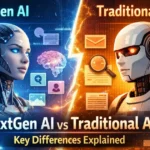
How is Next Gen AI different from traditional AI?
Traditional AI excels at narrow, well-defined tasks. Next Gen AI is generalist — capable of switching between tasks, reasoning about novel problems, generating creative content, and taking autonomous actions in the real world.
Is Next Gen AI Tools are safe to use?
Leading Next Gen AI Tools and systems include safety frameworks such as output filters, alignment training, and usage policies. Responsible use — including fact-checking outputs and understanding limitations — remains essential for every user and organization.
Do I need technical skills to use Next Gen AI?
No. The best Next Gen AI tools in 2026 are designed for non-technical users. Plain-language prompting, no-code agent builders, and intuitive interfaces mean that anyone can start extracting value from AI within hours of getting started.