If you’ve been scrolling through tech news lately, you’ve probably bumped into the term “AI agents” more than once. It sounds futuristic — maybe even a little intimidating. But here’s the thing: AI agents are actually a pretty intuitive concept once you strip away the jargon. Let’s break it down together.
Table of Contents
Think of an AI agent as a digital helper that doesn’t just answer your questions — it actually does things for you.
You know how a regular chatbot will tell you, “Here are three restaurants near you”? An AI agent would go ahead and book the table. That’s the key difference. Agents don’t just generate text and stop. They take actions, make decisions, and complete tasks on your behalf — sometimes without you having to lift a finger after the first instruction.
So What Makes Something an “Agent”?
A few ingredients go into making an AI system truly “agentic”:
1. A goal to work toward An agent is given an objective, not just a single prompt. While standard generative AI tools focus on generating a single piece of content based on what you ask, an AI agent takes it a step further: “Research this topic, find the best sources, write a summary, and email it to my team by 3 PM.”
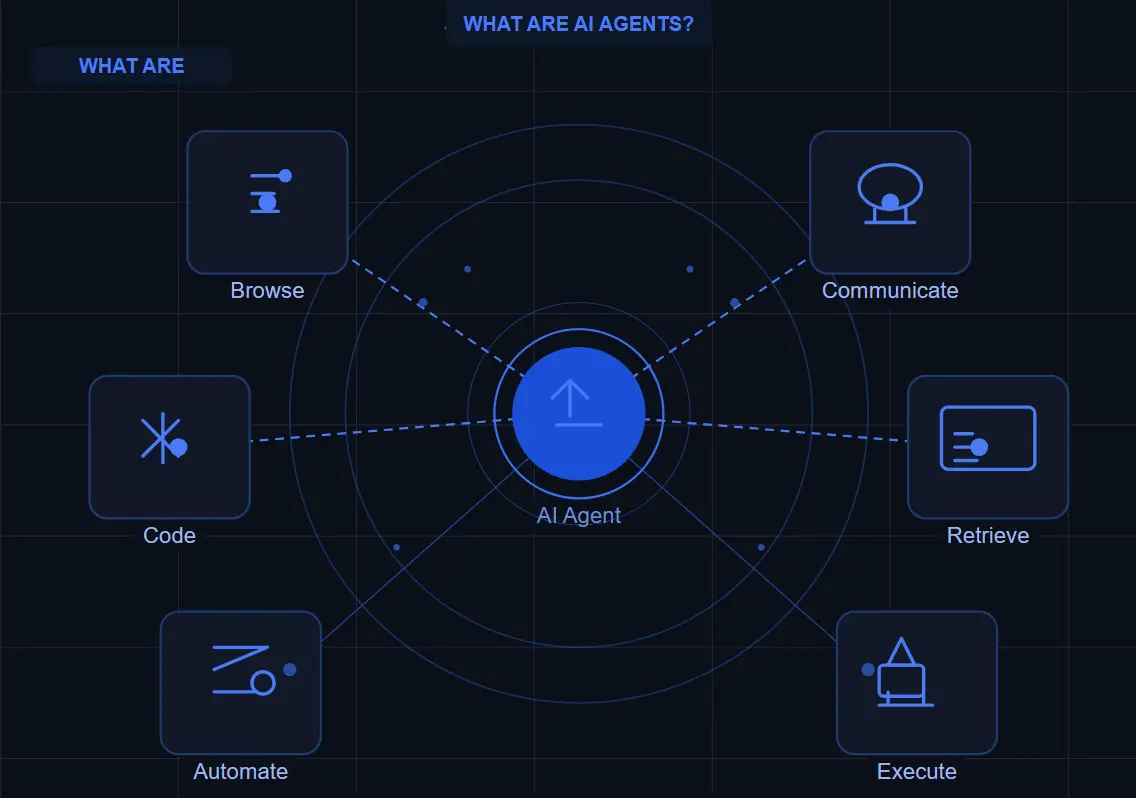
2. The ability to take actions This is the big one. Agents can interact with tools, websites, apps, and APIs. They can click buttons, fill out forms, search the web, run code, send messages — you name it.
3. Decision-making along the way Because real-world tasks rarely go in a straight line, agents need to make judgment calls. If step three of a plan doesn’t work, a good agent figures out an alternative rather than throwing its hands up.
4. Memory (sometimes) Some agents can remember context across a session or even across multiple conversations, making them smarter and more useful over time.
What Do AI Agents Actually Look Like in the Wild?
AI agents aren’t just a lab concept anymore — they’re showing up in real products and workflows right now.
Browser agents are one of the most talked-about types. These agents can open a web browser, navigate pages, read content, and interact with websites just like a human would. Google has even begun factoring agent-friendliness into how it thinks about websites, noting that browser agents may analyze a page’s visual rendering, inspect its structure, and interpret its accessibility tree to gather the information they need.
Customer service agents can handle entire support conversations — looking up order history, processing refunds, escalating issues — without handing off to a human unless things get truly complicated.
Research agents can take a broad question, fan it out into dozens of sub-queries, pull information from multiple sources, synthesize it, and hand you a clean report. This is actually similar to how Google’s AI-powered search works under the hood — generating related queries and pulling together relevant results to give you a richer answer.
Coding agents (like GitHub Copilot’s more advanced features or tools like Claude Code) can write code, run it, catch errors, fix them, and iterate — acting more like a junior developer than a simple autocomplete tool.
Why Is Everyone So Excited (and Slightly Nervous)?
The excitement is easy to understand: AI agents have the potential to save enormous amounts of time. Tasks that used to take hours of clicking, copying, and coordinating could be handed off to an agent and done in minutes.
But the nervousness makes sense too. When an AI is just generating text, the worst it can do is say something wrong. But as we transition into the era of NextGen AI, where systems are taking actions — sending emails, making purchases, or modifying files — the stakes become much higher.r. A mistake isn’t just a wrong answer; it’s a wrong action with real consequences.
That’s why the best AI agent systems are designed with guardrails: human approval checkpoints, limited permissions, and clear boundaries on what the agent can and can’t do.
What Does This Mean for Websites and Businesses?
Here’s where it gets interesting for anyone who owns or runs a website. As AI agents become more capable, they’ll increasingly be the ones visiting your website on behalf of users — not humans directly.
An agent helping someone plan a trip might visit your hotel’s site, read your rates, check your availability, and complete a booking — all in one automated flow. This is pushing businesses to think about how “agent-ready” their websites are: Is the content easy for an agent to read and understand? Are the important actions (booking, buying, contacting) easy for an agent to complete?
Google and other platforms are already working on protocols to make these kinds of agent-to-website interactions smoother and more standardized. It’s a shift that’s just beginning, but it’s worth paying attention to now.
Frequently Asked Questions About AI Agents
Is an AI agent the same as a chatbot?
Not quite. A chatbot is designed to have a conversation — it listens, responds, and waits for your next message. An AI agent goes further by actually doing things: browsing the web, filling out forms, sending emails, or running code. Think of a chatbot as a knowledgeable friend and an agent as that same friend who also runs your errands.
Do AI agents work on their own, or do they need human input?
It depends on how they’re designed. Some agents are “fully autonomous” and complete a task start to finish without checking in. Others are “human-in-the-loop,” meaning they pause at key decision points and ask for your approval before moving forward. For anything high-stakes — like making purchases or sending communications — the human-in-the-loop approach is generally the safer bet right now.
Are AI agents safe to use?
They can be, when built responsibly. The main risks come from agents taking wrong actions rather than just giving wrong answers. Good agent systems address this with limited permissions (the agent can only access what it needs), audit trails (a log of everything the agent did), and approval checkpoints for sensitive actions. As with any powerful tool, the safety largely depends on how it’s designed and deployed.
What’s the difference between an AI agent and AI automation?
Traditional automation follows a fixed script: if X happens, do Y — no flexibility. An AI agent can reason about a situation and adapt its approach on the fly. If a website’s layout changes or an unexpected error pops up, an AI agent can problem-solve around it. Classic automation would simply fail.
Will AI agents replace human jobs?
This is the big question, and the honest answer is: some tasks, yes — some roles, potentially. But most experts see agents as tools that augment human work rather than wholesale replace it. They’re great at repetitive, multi-step digital tasks. They’re still not great at nuanced judgment, creative thinking, or handling truly novel situations. The people who learn to work with agents effectively will likely have a significant advantage going forward.
How does Google Search relate to AI agents?
Google’s newer AI-powered search features — like AI Overviews and AI Mode — use agent-like techniques under the hood. When you ask a complex question, the system doesn’t just look up one thing; it fans out into multiple related queries, pulls from various sources, synthesizes the results, and presents you with a well-rounded answer. Google is also actively preparing its search ecosystem for browser agents that visit and interact with websites on users’ behalf.
How can I make my website ready for AI agents?
Start with the basics: make sure your content is clear, well-structured, and easy to read. Ensure important actions on your site (booking, buying, contacting) are straightforward to complete. Good accessibility practices — proper HTML structure, descriptive labels, logical page flow — also help agents navigate your site more effectively. Think of it as making your site friendly for a very capable, very literal visitor.
The Bottom Line
AI agents are, at their core, AI systems that act — not just systems that talk. They’re designed to take a goal, figure out the steps, use available tools, and get the job done.
We’re still in the early innings. Today’s agents are impressive but imperfect. They can get confused, make mistakes, and occasionally go off-script. But the trajectory is clear: agents are going to become a bigger and bigger part of how we interact with technology — and how technology interacts with the world on our behalf.
The more you understand them now, the better prepared you’ll be for what’s coming next. Found this helpful? Share it with someone who’s still wondering what all the AI fuss is about.